🤔🤔🤔
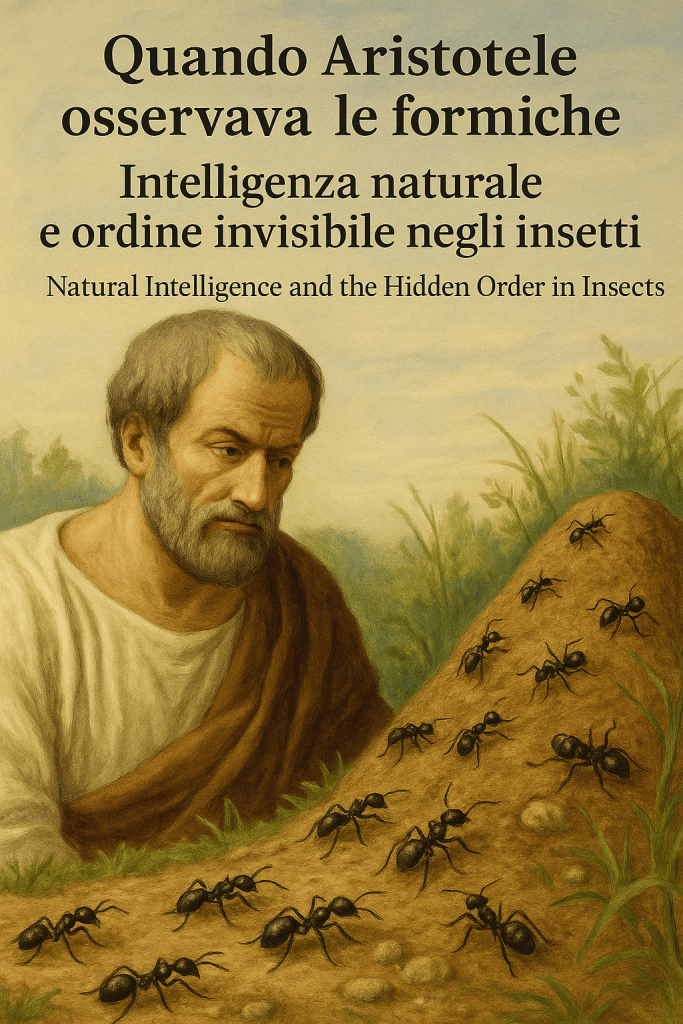
🐜 Title ENG:
“When Aristotle Watched the Ants: Natural Intelligence and the Hidden Order in Insects”
🇮🇹 INTRODUZIONE
Gli insetti non sono solo piccoli esseri che si muovono meccanicamente nel mondo vegetale: sono testimoni viventi di un ordine sottile, perfetto, che richiama a una visione della natura come mente ordinatrice. Questo pensiero, apparentemente moderno, ha radici profonde nel pensiero di Aristotele. In questo articolo esploreremo come gli insetti — in particolare quelli sociali — incarnino la physis aristotelica, ossia una natura dotata di scopo e intelligenza. E lo faremo intrecciando scienza, filosofia e manutenzione del verde.
🇬🇧 INTRODUCTION
Insects are not just tiny creatures moving mechanically through vegetation. They are living proof of a subtle, perfect order — one that recalls the ancient vision of nature as an intelligent, organizing principle. Surprisingly, this idea dates back to Aristotle. In this article, we explore how insects — especially social species — reflect Aristotle’s physis: a nature with purpose and intelligence. This is a story that blends science, philosophy, and green care practice.
🇮🇹 1. La natura intelligente secondo Aristotele
Per Aristotele, la natura (physis) non è un insieme casuale di eventi ma un principio attivo che tende verso un fine (telos). Ogni organismo, ogni comportamento, ogni struttura biologica esiste per uno scopo. Non è Dio a ordinare tutto, ma è la natura stessa che agisce come se fosse intelligente.
“La natura non fa nulla invano.” — Aristotele, De Anima
🇬🇧 1. Aristotle’s View of an Intelligent Nature
For Aristotle, nature (physis) is not a random collection of events but an active principle moving toward a goal (telos). Every organism, behavior, and structure exists for a reason. It’s not a divine will that imposes order, but nature itself that acts as if it were intelligent.
“Nature does nothing in vain.” — Aristotle, De Anima
🇮🇹 2. Gli insetti come prova di razionalità biologica
Pensiamo a una colonia di formiche. Senza un leader centrale, queste creature costruiscono, difendono, raccolgono, e si adattano in modo estremamente efficiente. Non hanno coscienza individuale, ma l’intero sistema si comporta come un’intelligenza distribuita. Per Aristotele, questo era l’esempio perfetto di natura intelligente in azione.
Stessa cosa per api, termiti, vespe cartonaie: cooperazione, divisione dei ruoli, architettura perfetta.
🇬🇧 2. Insects as Evidence of Biological Rationality
Consider an ant colony. Without a central leader, these creatures build, defend, forage, and adapt with stunning efficiency. They lack individual consciousness, yet the entire system behaves like a distributed intelligence. For Aristotle, this was a perfect example of intelligent nature at work.
Bees, termites, and paper wasps do the same: cooperation, role division, architectural mastery.
🇮🇹 3. L’ordine nascosto delle forme
Il mimetismo dei lepidotteri, la simbiosi tra formiche e afidi, la metamorfosi degli insetti: ogni fenomeno ci mostra un mondo organizzato, strutturato come un codice. Non è l’intelligenza di un singolo insetto che stupisce, ma la complessità del sistema che lo circonda.
Per Aristotele, era la forma (eidos) — non solo la materia — a determinare la realtà. Negli insetti questa forma è evidente.
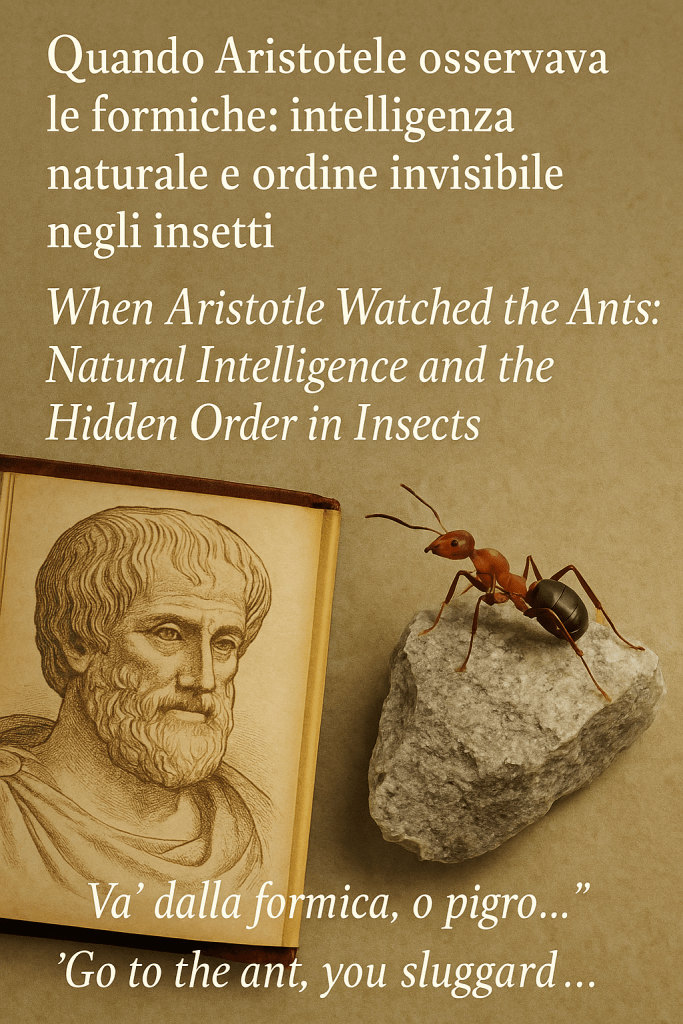
🇬🇧 3. The Hidden Order of Forms
Butterfly mimicry, ant-aphid symbiosis, insect metamorphosis: each of these shows a structured world, almost like a code. It’s not the intelligence of a single insect that amazes us, but the complexity of the system it’s part of.
For Aristotle, it was the form (eidos) — not just matter — that shaped reality. In insects, this form becomes visible.
🇮🇹 4. Natura e manutenzione: un’eredità aristotelica
Il manutentore del verde moderno si muove in un ambiente vivo. Riconoscere gli insetti non come “parassiti” ma come manifestazioni di un equilibrio più grande significa ereditare, inconsapevolmente, la visione aristotelica: ogni cosa ha il suo posto, il suo ruolo, il suo fine.
La gestione del verde, se fatta con rispetto e osservazione, diventa atto filosofico.
🇬🇧 4. Nature and Garden Work: An Aristotelian Legacy
Today’s green worker moves through a living environment. Seeing insects not as “pests” but as expressions of a greater balance means, unknowingly, inheriting Aristotle’s worldview: everything has its place, its role, its purpose.
Green care, when done with respect and attention, becomes a philosophical act.
🇮🇹 5. Intelligenza senza cervello?
Come si spiega tutto questo senza cadere nel misticismo? Oggi parliamo di “intelligenza emergente”, un fenomeno in cui l’insieme è più della somma delle parti. Gli insetti ci mostrano che non serve un cervello enorme per creare sistemi perfetti. Serve solo un ordine naturale che funziona da sé.
Aristotele lo direbbe così: la forma agisce nella materia.
🇬🇧 5. Intelligence Without a Brain?
How can we explain all this without sounding mystical? Today, we talk about “emergent intelligence,” where the whole is greater than the sum of its parts. Insects show us that you don’t need a big brain to build perfect systems. All it takes is a natural order that works on its own.
Aristotle would say it this way: form acts within matter.
🇮🇹 Conclusione: il pensiero sotto i nostri piedi
Gli insetti non sono solo oggetti di studio: sono porte verso una comprensione più profonda del mondo. Attraverso di loro, possiamo recuperare uno sguardo perduto: quello che vede nella natura una mente, un disegno, una finalità. Un’intuizione antica, ma attualissima.
Chi si prende cura del verde, lo fa anche per custodire questo pensiero invisibile.
🇬🇧 Conclusion: Thought Beneath Our Feet
Insects are not just subjects of study: they are gateways to a deeper understanding of the world. Through them, we can recover a lost gaze — one that sees in nature a mind, a design, a purpose. It’s an ancient idea, but more relevant than ever.
Those who care for green spaces do so to protect this invisible wisdom.
 458socom.org
Rispondi