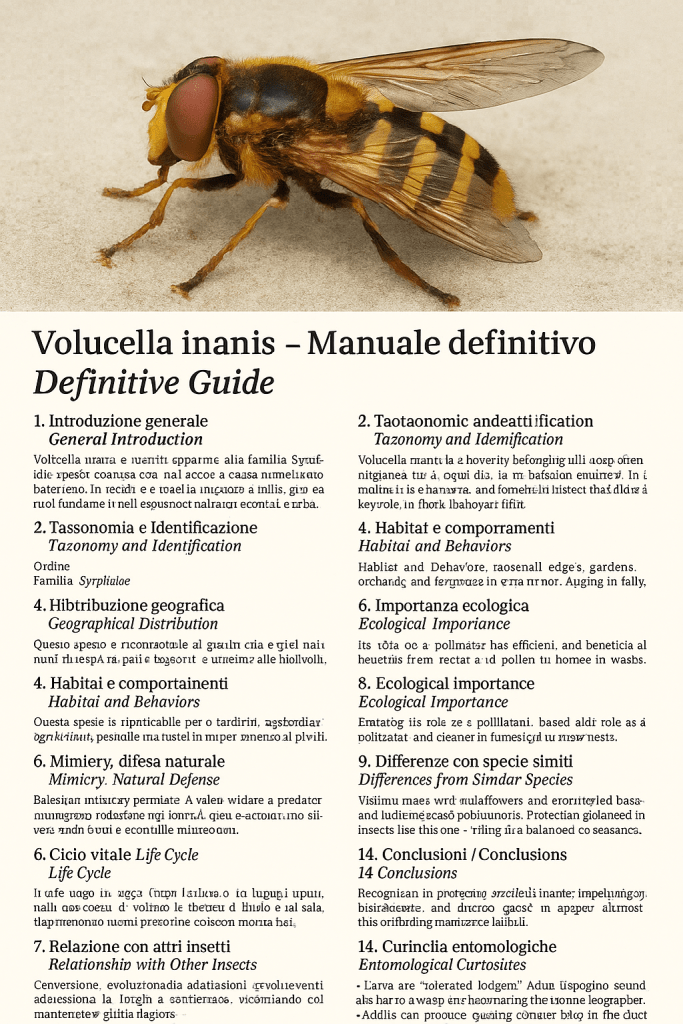
1. Introduzione generale / General Introduction
IT:
Volucella inanis è una mosca appartenente alla famiglia Syrphidae, spesso confusa con una vespa a causa del suo mimetismo batesiano. In realtà, è un insetto innocuo e utile, che svolge un ruolo fondamentale negli ecosistemi naturali e urbani. La sua presenza è indice di un ambiente equilibrato e ricco di biodiversità.
EN:
Volucella inanis is a hoverfly belonging to the Syrphidae family, often mistaken for a wasp due to its Batesian mimicry. In reality, it is a harmless and beneficial insect that plays a key role in both natural and urban ecosystems. Its presence indicates a healthy, biodiverse environment.
2. Tassonomia e identificazione / Taxonomy and Identification
IT:
- Ordine: Diptera
- Famiglia: Syrphidae
- Genere: Volucella
- Specie: Volucella inanis
Questa specie è riconoscibile per il corpo giallo e nero, molto simile a quello delle vespe. Le ali sono trasparenti con una leggera venatura bruna, il capo è grande con occhi composti, e il volo è tipicamente stazionario, come quello dei sirfidi.
EN:
- Order: Diptera
- Family: Syrphidae
- Genus: Volucella
- Species: Volucella inanis
This species is recognizable by its yellow and black body, very similar to that of wasps. The wings are transparent with light brown veins, the head is large with compound eyes, and it exhibits typical hoverfly flight behavior—hovering in place.
3. Distribuzione geografica / Geographical Distribution
IT:
Volucella inanis è presente in gran parte dell’Europa continentale, compresa l’Italia, con maggiore frequenza nelle aree collinari e boschive. È segnalata anche in alcune zone dell’Asia minore. Predilige habitat temperati con abbondanza di fioriture e nidi di imenotteri.
EN:
Volucella inanis is found throughout most of continental Europe, including Italy, and is more frequent in hilly and wooded areas. It has also been reported in parts of Asia Minor. It prefers temperate habitats with plenty of flowering plants and hymenopteran nests.
4. Habitat e comportamenti / Habitat and Behaviors
IT:
Questa mosca frequenta radure, margini di boschi, giardini, frutteti e prati fioriti. È attiva nei mesi caldi, da giugno a settembre. Gli adulti si nutrono di nettare e polline, svolgendo un ruolo importante nell’impollinazione.
EN:
This hoverfly inhabits clearings, woodland edges, gardens, orchards, and flowering meadows. It is active during the warm months, from June to September. Adults feed on nectar and pollen, playing an important role in pollination.
5. Mimicry: difesa naturale / Mimicry: Natural Defense
IT:
Il mimetismo batesiano permette a Volucella inanis di evitare i predatori, imitandone l’aspetto delle vespe (come Vespula vulgaris). Non possiede pungiglione né veleno, ma l’illusione visiva scoraggia molti predatori, tra cui uccelli e piccoli mammiferi.
EN:
Batesian mimicry allows Volucella inanis to avoid predators by mimicking the appearance of wasps (e.g., Vespula vulgaris). It has no sting or venom, but the visual illusion deters many predators, including birds and small mammals.
6. Ciclo vitale / Life Cycle
IT:
Il ciclo vitale di Volucella inanis comprende quattro fasi: uovo, larva, pupa, adulto.
- Oviposizione: Le femmine depongono le uova direttamente nei nidi di vespe o calabroni.
- Larva: Le larve sono saprofaghe e si nutrono di detriti organici, larve morte e residui nel nido dell’imenottero ospite.
- Pupa: Dopo alcune settimane, la larva si impupa nel suolo o all’interno del nido.
- Adulto: L’adulto emerge e vive alcune settimane, ripetendo il ciclo.
EN:
The life cycle of Volucella inanis includes four stages: egg, larva, pupa, adult.
- Egg-laying: Females lay eggs directly in wasp or hornet nests.
- Larva: The larvae are saprophagous, feeding on organic debris, dead larvae, and residues in the host’s nest.
- Pupa: After a few weeks, the larva pupates in the soil or within the nest.
- Adult: The adult emerges and lives for a few weeks, repeating the cycle.
7. Relazione con altri insetti / Relationship with Other Insects
IT:
Il legame tra Volucella inanis e le vespe è un perfetto esempio di adattamento evolutivo. Sebbene non sia un parassitoide vero e proprio, la larva trae vantaggio dal nido dell’imenottero ospite. In alcuni casi, può aiutare a mantenere l’igiene del nido, rimuovendo larve morte e rifiuti.
EN:
The relationship between Volucella inanis and wasps is a perfect example of evolutionary adaptation. While not a true parasitoid, the larva benefits from the host’s nest. In some cases, it may even help maintain nest hygiene by removing dead larvae and waste.
8. Importanza ecologica / Ecological Importance
IT:
Volucella inanis è un eccellente impollinatore. La sua attività favorisce la riproduzione di molte piante spontanee e coltivate. Inoltre, contribuisce all’equilibrio degli ecosistemi boschivi e agricoli, agendo come “sanitario” nei nidi di imenotteri.
EN:
Volucella inanis is an excellent pollinator. Its activity supports the reproduction of many wild and cultivated plants. Furthermore, it contributes to the balance of forest and agricultural ecosystems by acting as a “cleaner” in hymenopteran nests.
9. Differenze con specie simili / Differences from Similar Species
IT:
Può essere confusa con Volucella zonaria (più grande e più rossastra) e con Eristalis spp., che però hanno un aspetto più simile a quello delle api. Anche alcune vespe vere, come Polistes dominula, hanno una morfologia simile. Osservare il volo stazionario è un buon metodo per distinguere i sirfidi.
EN:
It can be confused with Volucella zonaria (larger and more reddish) and with Eristalis species, which resemble bees more than wasps. Some true wasps like Polistes dominula also have similar morphology. Observing hovering flight is a good way to identify hoverflies.
10. Monitoraggio e osservazione / Monitoring and Observation
IT:
Per osservare Volucella inanis, è utile frequentare zone ricche di fiori selvatici e tenere d’occhio i nidi di vespe. L’uso di fototrappole e la fotografia macro aiutano nell’identificazione. Non è necessario catturarla: è sufficiente documentarla visivamente.
EN:
To observe Volucella inanis, visit areas with abundant wildflowers and monitor wasp nests. Trail cameras and macro photography help with identification. There is no need to capture it—visual documentation is enough.
11. Protezione e conservazione / Protection and Conservation
IT:
Nonostante non sia una specie in pericolo, Volucella inanis è sensibile all’uso intensivo di pesticidi, alla perdita di habitat e alla riduzione delle popolazioni di vespe. Proteggere la biodiversità significa anche garantire la sopravvivenza di insetti come lei.
EN:
Although not endangered, Volucella inanis is sensitive to intensive pesticide use, habitat loss, and declining wasp populations. Protecting biodiversity also means ensuring the survival of insects like this one.
12. Utilità per il manutentore del verde / Value for Green Maintenance Workers
IT:
Per il manutentore del verde, riconoscere e tutelare Volucella inanis è sinonimo di buona gestione ambientale. Favorire la presenza di questa mosca significa promuovere l’impollinazione naturale e il controllo biologico dei rifiuti organici nei nidi di vespe, senza danneggiare l’ecosistema.
EN:
For green maintenance workers, recognizing and protecting Volucella inanis is part of good environmental management. Encouraging the presence of this hoverfly promotes natural pollination and biological waste control in wasp nests, without harming the ecosystem.
13. Curiosità entomologiche / Entomological Curiosities
IT:
- Le larve sono talvolta chiamate “inquiline tollerate” dai nidi ospiti.
- Gli adulti possono emettere un suono simile a un ronzio di vespa, accentuando il mimetismo.
- È uno degli insetti più fotografati dai macrofotografi per via del suo aspetto appariscente.
EN:
- The larvae are sometimes called “tolerated lodgers” of the host nests.
- Adults can produce a buzzing sound similar to a wasp, enhancing the mimicry.
- It is one of the most photographed insects by macro photographers due to its striking appearance.
14. Conclusioni / Conclusions
IT:
Volucella inanis è un prezioso alleato della natura: impollinatore, bioindicatore, “ospite discreto” nei nidi altrui. Comprenderla significa migliorare la gestione del verde e favorire una coesistenza equilibrata tra uomo e insetti.
EN:
Volucella inanis is a valuable ally of nature: pollinator, bioindicator, and “discreet guest” in others’ nests. Understanding it helps improve green space management and fosters a balanced coexistence between humans and insects.
 458socom.org
Rispondi