🇬🇧🇦🇹🇬🇧🇦🇹🇬🇧🇦🇹
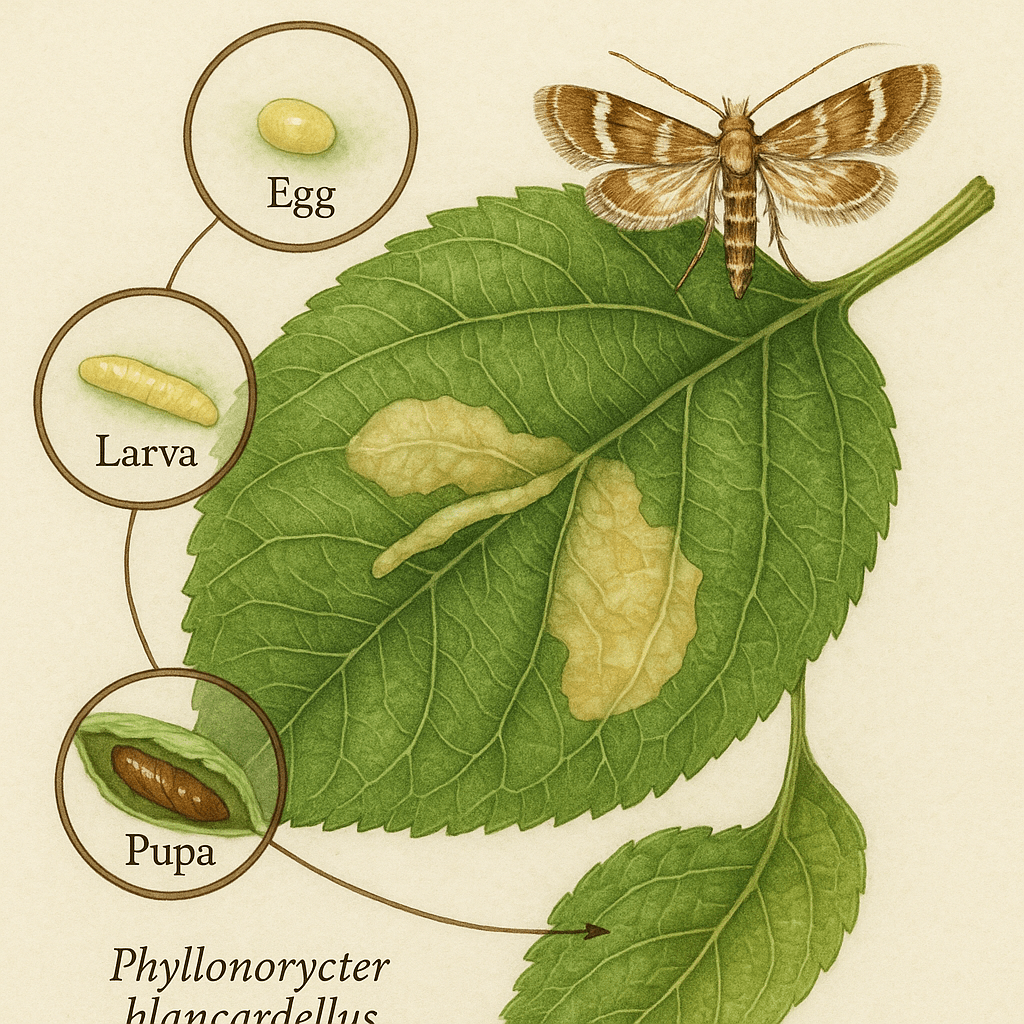
Phyllonorycter blancardellus: a Silent Threat to Apple Trees
Identità dell’insetto
Insect Identity
Phyllonorycter blancardellus è un microlepidottero della famiglia Gracillariidae, noto in tutta Europa come minatore delle foglie del melo. Di dimensioni minuscole, è spesso ignorato a prima vista, ma i suoi effetti possono compromettere seriamente la salute delle piante da frutto, in particolare il melo (Malus domestica).
Phyllonorycter blancardellus is a micro-moth belonging to the Gracillariidae family, commonly known across Europe as the apple leaf miner. Tiny in size, it often goes unnoticed at first glance, but its impact can seriously compromise the health of fruit trees, especially apple trees (Malus domestica).
Descrizione morfologica
Morphological Description
L’adulto ha un’apertura alare di circa 7–9 mm. Le ali anteriori sono strette, dorate con striature bianche e argentee; le posteriori sono grigie e frangiate. Le antenne sono filiformi e relativamente lunghe. Le larve, di colore bianco-giallastro, sono appiattite e si muovono all’interno delle foglie, creando mine caratteristiche.
The adult has a wingspan of about 7–9 mm. The forewings are narrow, golden with white and silvery streaks; the hindwings are grey and fringed. Antennae are thread-like and relatively long. The larvae, yellowish-white in color, are flattened and move inside the leaves, creating distinctive mines.
Ciclo biologico
Life Cycle
Questa specie può avere fino a 4 generazioni l’anno, a seconda del clima. Le uova vengono deposte sulla pagina inferiore delle foglie. Dopo pochi giorni, nasce una larva che inizia subito a nutrirsi del parenchima fogliare, scavando una mina visibile. Alla fine dello sviluppo, la larva si impupa all’interno della mina stessa, spesso protetta da un sottile strato sericeo.
This species can produce up to four generations per year, depending on the climate. Eggs are laid on the underside of leaves. After a few days, a larva hatches and begins feeding on the leaf tissue, creating a visible mine. At the end of its development, the larva pupates within the mine, often protected by a thin silk layer.
Danni provocati
Damage Caused
Le mine sono piccole vesciche traslucide che indeboliscono la foglia. Quando numerose, possono ridurre la fotosintesi, indebolire l’albero e compromettere lo sviluppo dei frutti. Le foglie infestati tendono a seccarsi e cadere prematuramente, riducendo la resa della pianta.
The mines appear as small translucent blisters that weaken the leaf. When numerous, they reduce photosynthesis, weaken the tree, and compromise fruit development. Infested leaves tend to dry out and fall prematurely, reducing the plant’s productivity.
Piante ospiti
Host Plants
Il principale ospite è il melo, ma sono stati segnalati attacchi anche su pero e cotogno. In frutteti intensivi o impianti trascurati, la presenza di Phyllonorycter blancardellus può diventare cronica, con infestazioni che si ripetono anno dopo anno.
The main host is the apple tree, but infestations have also been observed on pear and quince. In intensive orchards or neglected plantations, the presence of Phyllonorycter blancardellus can become chronic, with recurring infestations year after year.
Fattori favorenti
Favorable Conditions
Un clima mite e primavere anticipate favoriscono la comparsa precoce della prima generazione. La mancanza di predatori naturali o la distruzione degli equilibri biologici (ad esempio per uso eccessivo di insetticidi) possono favorire la proliferazione della specie.
Mild weather and early springs promote the early appearance of the first generation. The lack of natural predators or the disruption of ecological balances (e.g., due to excessive insecticide use) can lead to the proliferation of this species.
Identificazione sul campo
Field Identification
Osservando la pagina inferiore delle foglie a fine primavera o estate, si possono notare piccole macchie traslucide o giallastre. Alla luce, si vedono chiaramente le larve all’interno. Talvolta, si può notare l’adulto che vola via quando si scuote la pianta.
By inspecting the underside of the leaves in late spring or summer, small translucent or yellowish spots can be seen. With backlight, larvae inside the leaf become clearly visible. Occasionally, the adult moth can be seen flying off when the plant is disturbed.
Strategie di monitoraggio
Monitoring Strategies
Il monitoraggio si effettua tramite l’osservazione diretta delle mine e delle larve, oppure usando trappole adesive gialle. In frutteti commerciali, è utile registrare la comparsa dei primi adulti e correlare con i dati climatici per prevedere le generazioni successive.
Monitoring is carried out through direct observation of mines and larvae, or using yellow sticky traps. In commercial orchards, it’s useful to record the appearance of the first adults and correlate this with climate data to forecast subsequent generations.
Metodi di controllo
Control Methods
Controllo culturale
Cultural Control
Una buona potatura, l’eliminazione delle foglie cadute e la gestione dell’ambiente possono ridurre i focolai. Eliminare i residui vegetali aiuta a distruggere le crisalidi svernanti.
Good pruning, removal of fallen leaves, and environmental management can reduce infestations. Removing plant residues helps destroy overwintering pupae.
Controllo biologico
Biological Control
Esistono diversi nemici naturali, tra cui parassitoidi imenotteri (es. Sympiesis sericeicornis). Favorire la biodiversità e creare habitat per questi antagonisti naturali è una strategia efficace nel lungo termine.
There are several natural enemies, including parasitoid wasps (e.g., Sympiesis sericeicornis). Encouraging biodiversity and creating habitats for these natural antagonists is an effective long-term strategy.
Controllo chimico
Chemical Control
In caso di infestazioni gravi, possono essere impiegati insetticidi sistemici, ma è importante rispettare i tempi di carenza e le linee guida fitosanitarie. L’uso frequente di insetticidi può però indebolire i nemici naturali, peggiorando la situazione nel tempo.
In cases of severe infestation, systemic insecticides may be used, but it is essential to follow withdrawal periods and phytosanitary guidelines. Frequent use of insecticides, however, may weaken natural enemies, worsening the situation over time.
Ruolo negli ecosistemi
Role in Ecosystems
Nonostante i danni agricoli, Phyllonorycter blancardellus ha un ruolo ecologico: le sue larve sono cibo per molti insetti predatori e uccelli insettivori. Anche gli adulti contribuiscono al ciclo alimentare, specialmente nei frutteti naturali o semi-abbandonati.
Despite its agricultural damage, Phyllonorycter blancardellus plays an ecological role: its larvae are food for many predatory insects and insectivorous birds. Adults also contribute to the food chain, especially in natural or semi-abandoned orchards.
Invasività e distribuzione geografica
Invasiveness and Geographic Distribution
Originaria dell’Europa, questa specie è ormai presente in quasi tutto il continente, dal Mediterraneo al Baltico. È stata segnalata anche in Nord America, dove si sta lentamente diffondendo nei meleti. La sua capacità di adattarsi a climi diversi la rende una potenziale specie invasiva.
Originally from Europe, this species is now present across most of the continent, from the Mediterranean to the Baltic. It has also been reported in North America, where it is slowly spreading in apple orchards. Its ability to adapt to different climates makes it a potentially invasive species.
Prevenzione e gestione integrata
Prevention and Integrated Management
La lotta integrata (IPM) è la chiave per un controllo efficace e sostenibile. Essa combina monitoraggio costante, interventi mirati, rispetto della biodiversità e interventi chimici solo se strettamente necessari.
Integrated Pest Management (IPM) is key to effective and sustainable control. It combines constant monitoring, targeted interventions, biodiversity conservation, and chemical use only when strictly necessary.
Conclusione
Conclusion
Phyllonorycter blancardellus rappresenta un esempio emblematico di come anche un insetto minuscolo possa creare problemi rilevanti nel verde ornamentale e produttivo. Riconoscerne precocemente la presenza, adottare strategie ecologiche e limitare l’uso di pesticidi è essenziale per proteggere i meleti e l’ambiente.
Phyllonorycter blancardellus is a striking example of how even a tiny insect can cause major issues in both ornamental and productive green spaces. Early detection, ecological strategies, and limited pesticide use are essential to protect apple orchards and the environment.
 458socom.org
Rispondi