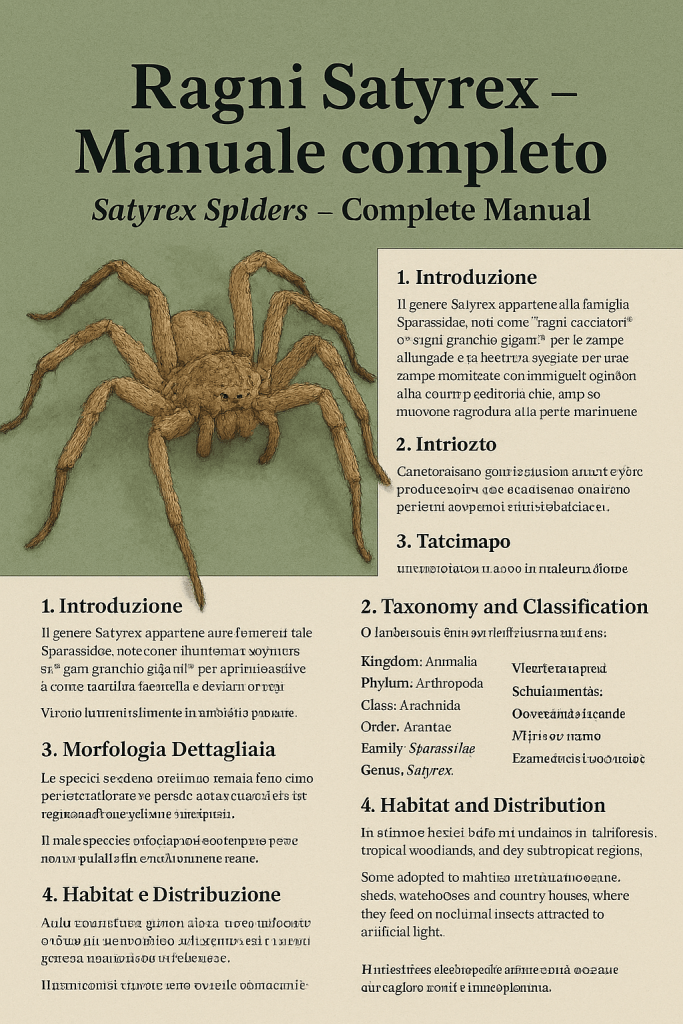
12. Specie Principali del Genere Satyrex / Key Species of the Genus Satyrex
IT:
Il genere Satyrex include attualmente cinque specie riconosciute:
- Satyrex ferox – la più grande e dal temperamento più aggressivo, con un’apertura delle zampe che può raggiungere i 14 cm. Al minimo disturbo solleva le zampe anteriori e produce un sibilo difensivo.
- Satyrex arabicus – diffusa nella Penisola Arabica, di dimensioni medie e colore bruno uniforme.
- Satyrex somalicus – tipica del Corno d’Africa, caratterizzata da colorazione mimetica e abitudini terricole.
- Satyrex speciosus – nota per la brillantezza della livrea e per i contrasti di colore sul corpo e sulle zampe.
- Satyrex longimanus – presenta palpi maschili insolitamente lunghi, da cui deriva il nome (“mani lunghe”).
EN:
The genus Satyrex currently includes five recognized species:
- Satyrex ferox – the largest and most aggressive, with a leg span of up to 14 cm. At the slightest disturbance, it raises its front legs and produces a defensive hiss.
- Satyrex arabicus – found in the Arabian Peninsula, medium-sized with a uniform brown coloration.
- Satyrex somalicus – typical of the Horn of Africa, featuring camouflaged coloration and ground-dwelling habits.
- Satyrex speciosus – known for its bright coloration and striking contrasts on the body and legs.
- Satyrex longimanus – has unusually long male palps, which inspired its name (“long hands”).
13. Adattamenti Riproduttivi Estremi / Extreme Reproductive Adaptations
IT:
Una caratteristica distintiva del genere è la straordinaria lunghezza dei palpi maschili, usati per il trasferimento dello sperma. In alcune specie, come S. ferox, possono essere quasi pari alla lunghezza delle zampe più lunghe. Questo permette al maschio di mantenere una certa distanza dalla femmina durante l’accoppiamento, riducendo il rischio di aggressioni o cannibalismo.
EN:
A distinctive feature of the genus is the extraordinary length of the male palps, used for sperm transfer. In some species, such as S. ferox, they can be nearly as long as the longest legs. This allows the male to maintain a safer distance from the female during mating, reducing the risk of aggression or cannibalism.
14. Comportamento Difensivo Estremo / Extreme Defensive Behavior
IT:
Specie come S. ferox mostrano un comportamento difensivo particolarmente evidente: in caso di minaccia alzano le zampe anteriori in segno di avvertimento e producono un sibilo attraverso lo sfregamento di peli specializzati. Questo serve sia a scoraggiare predatori sia a segnalare la propria pericolosità.
EN:
Species such as S. ferox display particularly striking defensive behavior: when threatened, they raise their front legs in a warning display and produce a hiss by rubbing specialized hairs together. This serves both to deter predators and signal their potential danger.
15. Distribuzione Geografica e Habitat / Geographic Distribution and Habitat
IT:
Le specie del genere si trovano principalmente tra il Corno d’Africa e la Penisola Arabica. Preferiscono ambienti asciutti e riparati, come fessure rocciose, tane scavate nel terreno o interstizi tra tronchi e radici. L’habitat offre loro microclimi più freschi e protezione dai predatori.
EN:
Species in the genus are found mainly between the Horn of Africa and the Arabian Peninsula. They prefer dry, sheltered environments such as rocky crevices, burrows in the ground, or gaps between logs and roots. These habitats provide cooler microclimates and protection from predators.
16. Significato del Nome / Significance of the Name
IT:
Il nome Satyrex unisce il termine “satyr”, figura mitologica nota per l’energia e l’esuberanza, e “rex”, che significa “re” in latino. È un chiaro richiamo alla morfologia e al comportamento riproduttivo eccezionale dei maschi.
EN:
The name Satyrex combines “satyr,” a mythological figure known for energy and exuberance, and “rex,” meaning “king” in Latin. It is a clear reference to the remarkable morphology and reproductive behavior of the males.
17. Ecologia Evolutiva e Conclusioni / Evolutionary Ecology and Conclusion
IT:
Il genere Satyrex è un esempio di come le pressioni evolutive possano modellare sia l’aspetto sia il comportamento di un animale. L’interazione tra femmine aggressive e maschi adattati a evitare il contatto diretto ha prodotto caratteristiche morfologiche uniche. Allo stesso tempo, la loro specializzazione nell’habitat e le strategie difensive li rendono predatori altamente efficienti e ben adattati ai loro ecosistemi.
EN:
The genus Satyrex is an example of how evolutionary pressures can shape both the appearance and behavior of an animal. The interaction between aggressive females and males adapted to avoid direct contact has produced unique morphological traits. At the same time, their habitat specialization and defensive strategies make them highly efficient predators well adapted to their ecosystems.
 458socom.org
Rispondi