🇦🇹🇬🇧🇦🇹🇬🇧🇦🇹🇬🇧
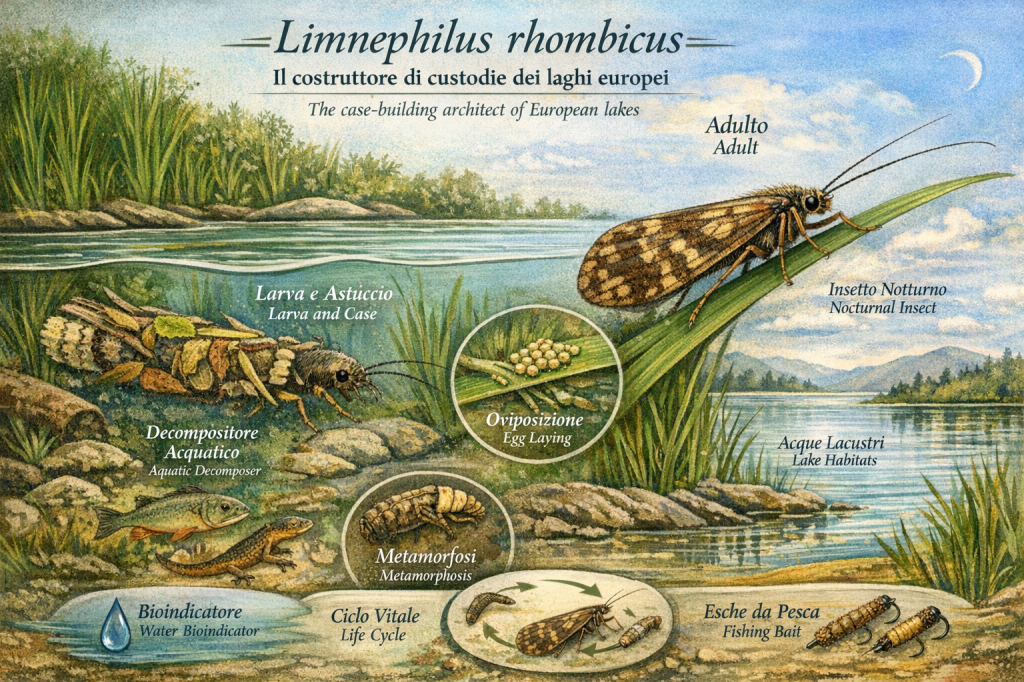
Il costruttore di custodie dei laghi europei
(The case-building architect of European lakes)
INTRODUZIONE
🇮🇹 Italiano
Limnephilus rhombicus è una delle specie più rappresentative dell’ordine dei Trichoptera, un gruppo di insetti spesso poco conosciuto dal grande pubblico ma di enorme importanza ecologica. Questo tricottero appartiene alla famiglia Limnephilidae, famosa per le larve costruttrici di astucci, vere e proprie architetture biologiche realizzate con materiali raccolti nell’ambiente acquatico.
In laghi, stagni, canali e acque calme di gran parte dell’Europa, Limnephilus rhombicus svolge un ruolo silenzioso ma cruciale: trasforma detrito organico in biomassa, alimenta pesci, anfibi e uccelli, e contribuisce al mantenimento della qualità dell’acqua.
Questa specie rappresenta un perfetto esempio di adattamento evolutivo agli ambienti dulcacquicoli, con un ciclo vitale complesso che alterna una fase acquatica altamente specializzata a una fase adulta terrestre e volante.
🇬🇧 English
Limnephilus rhombicus is one of the most representative species of the order Trichoptera, a group of insects that is often overlooked by the general public but plays an enormous ecological role. This caddisfly belongs to the family Limnephilidae, which is famous for its case-building larvae—true biological architectures made from materials collected in aquatic habitats.
In lakes, ponds, canals, and still waters across much of Europe, Limnephilus rhombicus performs a quiet yet essential role: it converts organic detritus into biomass, feeds fish, amphibians, and birds, and helps maintain water quality.
This species is a perfect example of evolutionary adaptation to freshwater environments, with a complex life cycle alternating between a highly specialized aquatic phase and a terrestrial flying adult stage.
CLASSIFICAZIONE E POSIZIONE SISTEMATICA
🇮🇹 Italiano
Limnephilus rhombicus appartiene all’ordine Trichoptera, comunemente noti come tricotteri o “friganee”. Questo ordine comprende oltre 16.000 specie descritte nel mondo ed è strettamente imparentato con i Lepidotteri (falene e farfalle).
La famiglia Limnephilidae è una delle più grandi famiglie di tricotteri dell’emisfero settentrionale. I suoi membri sono caratterizzati da larve robuste, costruttrici di astucci tubolari, spesso realizzati con frammenti vegetali.
Il genere Limnephilus include specie generalmente associate a ambienti stagnanti o a lento flusso, come paludi, laghi, stagni e torbiere. L. rhombicus si distingue per la sua ampia distribuzione e per la sua grande tolleranza ecologica.
🇬🇧 English
Limnephilus rhombicus belongs to the order Trichoptera, commonly known as caddisflies. This order includes over 16,000 described species worldwide and is closely related to Lepidoptera (moths and butterflies).
The family Limnephilidae is one of the largest caddisfly families in the Northern Hemisphere. Its members are characterized by robust larvae that build tubular cases, often using plant fragments.
The genus Limnephilus includes species typically associated with still or slow-flowing waters such as marshes, lakes, ponds, and bogs. L. rhombicus stands out for its wide distribution and high ecological tolerance.
MORFOLOGIA DELL’ADULTO
🇮🇹 Italiano
L’adulto di Limnephilus rhombicus è un insetto di medie dimensioni, con apertura alare che può superare i 30 millimetri. Il corpo è relativamente tozzo, ricoperto da una fitta peluria che conferisce un aspetto vellutato.
Le ali anteriori sono ampie e di colore bruno-marrone, spesso decorate da macchie più chiare che formano un disegno romboidale, da cui deriva il nome della specie. Le ali posteriori sono più chiare e membranose, utilizzate principalmente per il volo.
Le antenne sono lunghe e filiformi, tipiche dei tricotteri, e svolgono un ruolo sensoriale importante. Gli occhi sono grandi e ben sviluppati, adattati alla vita crepuscolare e notturna.
🇬🇧 English
The adult Limnephilus rhombicus is a medium-sized insect with a wingspan that can exceed 30 millimeters. Its body is relatively stout and covered in dense hairs, giving it a velvety appearance.
The forewings are broad and brownish, often decorated with lighter spots forming a rhomboid pattern from which the species takes its name. The hindwings are paler and more membranous, used primarily for flight.
The antennae are long and thread-like, typical of caddisflies, and play an important sensory role. The eyes are large and well developed, adapted to crepuscular and nocturnal activity.
LA LARVA E L’ASTUCCIO
🇮🇹 Italiano
La larva di Limnephilus rhombicus è una delle forme più affascinanti dell’intero ciclo vitale. Vive interamente sott’acqua e costruisce un astuccio protettivo utilizzando frammenti di foglie, steli, cortecce e detriti vegetali.
Questo astuccio ha una forma cilindrica e viene continuamente allungato man mano che la larva cresce. All’interno, la larva è protetta da predatori e dalle variazioni ambientali.
La larva possiede mandibole robuste per triturare materiale vegetale in decomposizione, alghe e microrganismi, svolgendo un ruolo chiave nel riciclaggio della materia organica nei laghi e nelle zone umide.
🇬🇧 English
The larva of Limnephilus rhombicus is one of the most fascinating stages of its life cycle. It lives entirely underwater and builds a protective case using fragments of leaves, stems, bark, and plant debris.
This case has a cylindrical shape and is continuously enlarged as the larva grows. Inside, the larva is protected from predators and environmental fluctuations.
The larva has strong mandibles for shredding decaying plant material, algae, and microorganisms, playing a key role in recycling organic matter in lakes and wetlands.
HABITAT E DISTRIBUZIONE
🇮🇹 Italiano
Limnephilus rhombicus è diffuso in gran parte dell’Europa, soprattutto nelle regioni temperate e settentrionali. Predilige ambienti d’acqua dolce ferma o a lento flusso, come laghi, stagni, torbiere, paludi e canali agricoli.
È particolarmente comune in acque ricche di vegetazione sommersa e materiale organico, che forniscono sia cibo che materiali da costruzione per le larve.
Grazie alla sua tolleranza verso acque leggermente eutrofiche, può sopravvivere anche in ambienti alterati dall’attività umana, rendendolo una specie importante per lo studio dell’ecologia delle acque interne.
🇬🇧 English
Limnephilus rhombicus is distributed across much of Europe, especially in temperate and northern regions. It prefers still or slow-moving freshwater environments such as lakes, ponds, bogs, marshes, and agricultural canals.
It is particularly common in waters rich in submerged vegetation and organic material, which provide both food and building materials for larvae.
Thanks to its tolerance of mildly eutrophic waters, it can survive in environments altered by human activity, making it an important species for studying freshwater ecology.
CICLO VITALE
🇮🇹 Italiano
Il ciclo vitale di Limnephilus rhombicus è annuale o biennale a seconda delle condizioni climatiche. Le uova vengono deposte sulla superficie dell’acqua o su piante acquatiche.
Dopo la schiusa, le larve attraversano diversi stadi di crescita, durante i quali ampliano progressivamente il loro astuccio. Questa fase può durare molti mesi.
Quando la larva è matura, si trasforma in pupa all’interno dell’astuccio. Dopo alcune settimane emerge l’adulto alato, che vive solo poche settimane, il tempo necessario per riprodursi.
🇬🇧 English
The life cycle of Limnephilus rhombicus is annual or biennial depending on climate. Eggs are laid on the water surface or on aquatic plants.
After hatching, larvae go through several growth stages, during which they gradually enlarge their case. This phase can last many months.
When the larva is mature, it pupates inside the case. After a few weeks, the winged adult emerges, living only a few weeks—just long enough to reproduce.
RUOLO ECOLOGICO
🇮🇹 Italiano
Limnephilus rhombicus è un importante decompositore. Le sue larve frammentano grandi quantità di materiale vegetale morto, facilitando il lavoro di batteri e funghi.
Inoltre, costituisce una fonte di cibo essenziale per pesci, rane, tritoni e uccelli acquatici. La presenza di popolazioni sane indica un ecosistema acquatico funzionale.
🇬🇧 English
Limnephilus rhombicus is an important decomposer. Its larvae break down large amounts of dead plant material, facilitating the work of bacteria and fungi.
It is also a vital food source for fish, frogs, newts, and aquatic birds. Healthy populations indicate a functioning aquatic ecosystem.
IMPORTANZA PER L’UOMO
🇮🇹 Italiano
Questa specie è utilizzata come bioindicatore della qualità delle acque e come modello per lo studio delle reti trofiche. Inoltre, le larve di tricotteri sono usate come esche da pesca.
🇬🇧 English
This species is used as a bioindicator of water quality and as a model for studying food webs. Caddisfly larvae are also used as fishing bait.
CONCLUSIONE
🇮🇹 Italiano
Limnephilus rhombicus rappresenta una delle forme più raffinate di adattamento agli ambienti acquatici. La sua vita nascosta nei laghi europei sostiene catene alimentari, ricicla nutrienti e contribuisce alla stabilità degli ecosistemi.
🇬🇧 English
Limnephilus rhombicus represents one of the most refined adaptations to aquatic environments. Its hidden life in European lakes supports food chains, recycles nutrients, and contributes to ecosystem stability.
 458socom.org
Rispondi