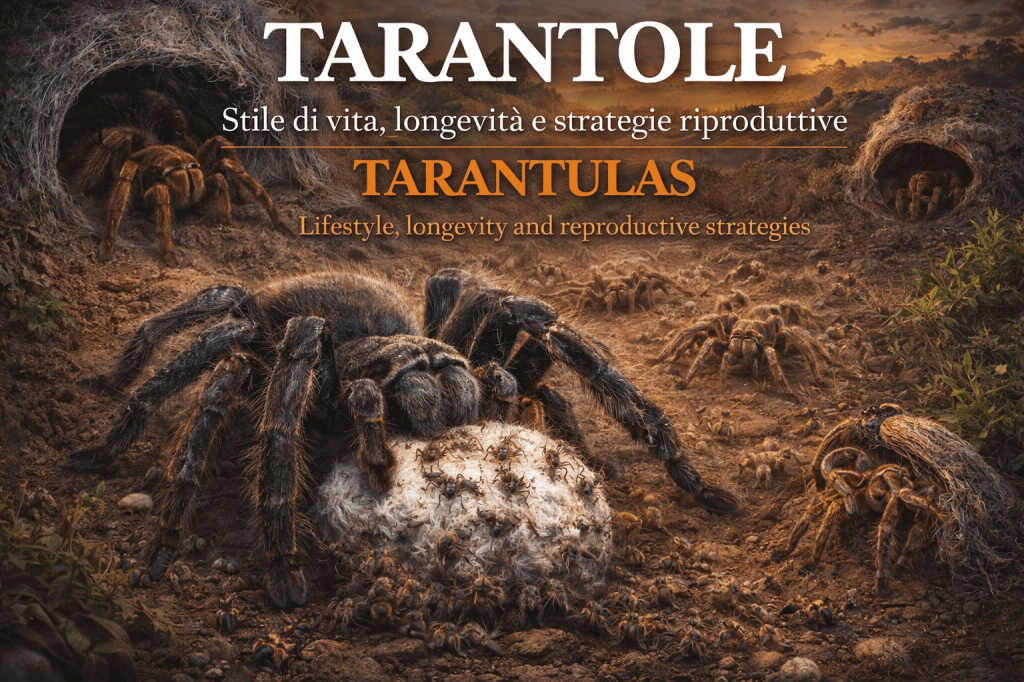
Lifestyle, longevity and reproductive strategies of tarantulas: a balance between survival and adaptation
Introduzione: una vita lenta ma estremamente efficiente
Introduction: a slow yet extremely efficient life
Le tarantole, appartenenti alla famiglia Theraphosidae, rappresentano uno dei modelli più affascinanti di adattamento evolutivo tra gli artropodi terrestri. Il loro stile di vita si basa su un equilibrio raffinato tra consumo energetico ridotto, capacità predatoria e strategie difensive efficaci. A differenza di molti insetti e altri invertebrati caratterizzati da cicli vitali rapidi, le tarantole adottano un approccio opposto, fondato sulla lentezza, sulla conservazione dell’energia e su una sorprendente longevità.
Tarantulas, belonging to the family Theraphosidae, represent one of the most fascinating models of evolutionary adaptation among terrestrial arthropods. Their lifestyle is based on a refined balance between reduced energy consumption, predatory ability and effective defensive strategies. Unlike many insects and other invertebrates characterized by rapid life cycles, tarantulas adopt the opposite approach, based on slowness, energy conservation and remarkable longevity.
Stile di vita: immobilità apparente e percezione costante
Lifestyle: apparent stillness and constant perception
Lo stile di vita delle tarantole è spesso interpretato come statico, ma questa immobilità è solo apparente. In realtà si tratta di una strategia altamente sofisticata. Le tarantole passano gran parte della loro vita immobili all’ingresso della tana o all’interno di rifugi naturali, riducendo al minimo il consumo energetico.
The lifestyle of tarantulas is often interpreted as static, but this stillness is only apparent. In reality it is a highly sophisticated strategy. Tarantulas spend most of their lives motionless at the entrance of their burrow or inside natural shelters, minimizing energy consumption.
Questa inattività non è passività. Il corpo è costantemente in uno stato di vigilanza, capace di percepire le più piccole vibrazioni del suolo. Attraverso sensori distribuiti sulle zampe, l’animale costruisce una vera e propria mappa vibratoria dell’ambiente circostante.
This inactivity is not passivity. The body is constantly in a state of alert, capable of detecting even the smallest ground vibrations. Through sensors distributed on their legs, the animal builds a true vibrational map of the surrounding environment.
La tana: centro della vita
The burrow: center of life
La tana rappresenta il fulcro dell’esistenza della tarantola. Non è solo un rifugio, ma un sistema complesso che garantisce protezione, stabilità termica e sicurezza.
The burrow represents the core of the tarantula’s existence. It is not just a shelter, but a complex system that provides protection, thermal stability and safety.
Alcune specie scavano attivamente nel terreno, mentre altre sfruttano cavità naturali. L’interno viene spesso rivestito con seta, creando una struttura stabile e sensibile alle vibrazioni.
Some species actively dig into the ground, while others exploit natural cavities. The interior is often lined with silk, creating a stable structure sensitive to vibrations.
Questa tana diventa un’estensione del corpo dell’animale, un’interfaccia tra individuo e ambiente.
This burrow becomes an extension of the animal’s body, an interface between organism and environment.
Longevità: una strategia evolutiva unica
Longevity: a unique evolutionary strategy
Uno degli aspetti più sorprendenti delle tarantole è la loro longevità. Le femmine possono vivere per decenni, superando spesso i venti anni e, in alcuni casi, raggiungendo età ancora più avanzate.
One of the most surprising aspects of tarantulas is their longevity. Females can live for decades, often exceeding twenty years and in some cases reaching even greater ages.
I maschi, al contrario, hanno una vita significativamente più breve. Dopo aver raggiunto la maturità sessuale, il loro obiettivo principale diventa la riproduzione, e la loro esistenza si conclude generalmente poco tempo dopo.
Males, on the other hand, have a significantly shorter lifespan. After reaching sexual maturity, their main objective becomes reproduction, and their life usually ends shortly after.
Questa differenza riflette due strategie evolutive distinte: stabilità e accumulo nel caso delle femmine, rapidità e rischio nel caso dei maschi.
This difference reflects two distinct evolutionary strategies: stability and accumulation in females, speed and risk in males.
Crescita e mute: un processo continuo
Growth and molting: a continuous process
La crescita delle tarantole avviene attraverso un processo chiamato muta. Durante questo evento, l’animale abbandona il vecchio esoscheletro per formarne uno nuovo.
Tarantula growth occurs through a process called molting. During this event, the animal sheds its old exoskeleton to form a new one.
Questo momento è estremamente delicato. L’individuo è vulnerabile e necessita di un ambiente sicuro.
This moment is extremely delicate. The individual is vulnerable and requires a safe environment.
Con il passare del tempo, le mute diventano meno frequenti, segnando il rallentamento del ciclo vitale.
Over time, molting becomes less frequent, marking a slowdown in the life cycle.
Riproduzione: un incontro rischioso
Reproduction: a risky encounter
La riproduzione nelle tarantole è un processo complesso e spesso pericoloso. Il maschio deve localizzare la femmina seguendo segnali chimici e vibrazionali.
Reproduction in tarantulas is a complex and often dangerous process. The male must locate the female by following chemical and vibrational signals.
Una volta trovato il rifugio, si avvicina con cautela, producendo vibrazioni specifiche per segnalare la propria presenza.
Once he finds the shelter, he approaches cautiously, producing specific vibrations to signal his presence.
Se la femmina non riconosce correttamente questi segnali, può reagire come farebbe con una preda.
If the female does not correctly recognize these signals, she may react as she would to prey.
Deposizione delle uova e sviluppo
Egg laying and development
Dopo l’accoppiamento, la femmina depone le uova all’interno di un sacco ovigero costruito con seta.
After mating, the female lays eggs inside an egg sac built with silk.
Questo sacco rappresenta una struttura altamente protettiva, capace di mantenere condizioni stabili per lo sviluppo embrionale.
This sac provides a highly protective structure capable of maintaining stable conditions for embryonic development.
Durante questo periodo, la femmina riduce drasticamente la propria attività e si concentra sulla protezione della prole.
During this period, the female drastically reduces her activity and focuses on protecting her offspring.
Difesa materna: un comportamento sorprendente
Maternal defense: a surprising behavior
Uno degli aspetti più affascinanti delle tarantole è il comportamento materno. La femmina mostra un livello di protezione elevato nei confronti del sacco ovigero.
One of the most fascinating aspects of tarantulas is maternal behavior. The female shows a high level of protection toward the egg sac.
Rimane vicino ad esso, lo sposta se necessario e reagisce in modo aggressivo a qualsiasi minaccia.
She remains close to it, moves it if necessary and reacts aggressively to any threat.
Questa difesa è fondamentale per garantire la sopravvivenza delle uova e dei piccoli.
This defense is essential to ensure the survival of eggs and offspring.
I piccoli: indipendenza precoce
Spiderlings: early independence
Una volta schiuse, le giovani tarantole rimangono inizialmente vicine alla madre, ma non per lungo tempo.
Once hatched, young tarantulas initially remain close to the mother, but not for long.
Dopo le prime fasi, si disperdono nell’ambiente, iniziando una vita completamente autonoma.
After the initial stages, they disperse into the environment, beginning a fully independent life.
Questa strategia riduce la competizione e aumenta le probabilità di sopravvivenza della specie.
This strategy reduces competition and increases the species’ chances of survival.
Conclusione: lentezza, precisione e sopravvivenza
Conclusion: slowness, precision and survival
Le tarantole rappresentano un modello evolutivo basato sull’efficienza piuttosto che sulla velocità. Il loro stile di vita, la longevità e le strategie riproduttive dimostrano come la sopravvivenza possa essere garantita attraverso equilibrio e adattamento.
Tarantulas represent an evolutionary model based on efficiency rather than speed. Their lifestyle, longevity and reproductive strategies show how survival can be ensured through balance and adaptation.
Comprendere questi aspetti permette di superare la visione superficiale di questi animali e apprezzarne la complessità biologica.
Understanding these aspects allows us to move beyond a superficial view of these animals and appreciate their biological complexity.

 458socom.org
Rispondi