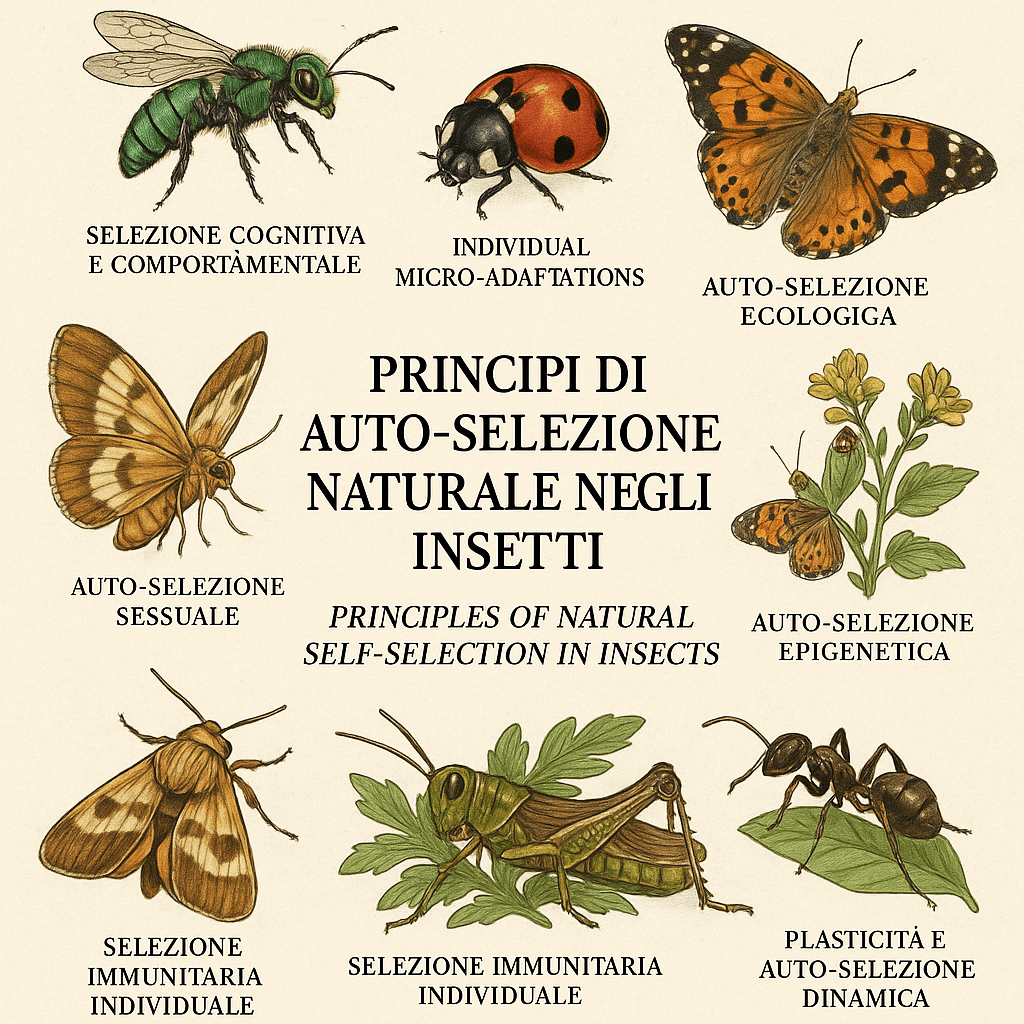
🧬 Principles of Natural Self-Selection in Insects
🌱 Introduzione | Introduction
IT
Nel mondo dell’entomologia, la selezione naturale è sempre stata uno dei motori principali dell’evoluzione. Tuttavia, quando parliamo di auto-selezione naturale, entriamo in un ambito ancora più sottile e affascinante: quello delle strategie individuali adottate dagli insetti per massimizzare la loro sopravvivenza e riproduzione. Si tratta di un processo in cui l’individuo diventa protagonista attivo, modellando il proprio destino attraverso micro-adattamenti, comportamenti appresi e scelte ecologiche.
EN
In the world of entomology, natural selection has always been one of the main drivers of evolution. However, when we talk about natural self-selection, we enter a subtler and more fascinating field: the individual strategies adopted by insects to maximize their survival and reproduction. It is a process in which the individual becomes an active protagonist, shaping its own destiny through micro-adaptations, learned behaviors, and ecological choices.
🧠 Selezione Cognitiva e Comportamentale | Cognitive and Behavioral Selection
IT
Molti insetti sono dotati di capacità cognitive sorprendenti, sebbene semplici. Alcune specie di formiche imparano a evitare determinate aree contaminate, mentre i bombi possono imparare percorsi ottimali verso fonti di nettare. Questa capacità di apprendimento, anche se limitata, consente una forma di auto-selezione comportamentale: gli individui che apprendono più rapidamente o adottano comportamenti più efficaci tendono a sopravvivere e riprodursi meglio.
EN
Many insects possess surprising cognitive abilities, albeit basic. Some ant species learn to avoid contaminated areas, while bumblebees can learn optimal paths to nectar sources. This learning capacity, though limited, allows a form of behavioral self-selection: individuals that learn faster or adopt more effective behaviors tend to survive and reproduce more successfully.
🔍 Micro-adattamenti individuali | Individual Micro-Adaptations
IT
Nel corso della loro vita, gli insetti affrontano sfide ambientali diverse: variazioni climatiche, competizione interspecifica, predazione. Ogni individuo, anche all’interno della stessa covata, può rispondere in maniera diversa. Alcuni esemplari sviluppano cuticole più dure, altri variano leggermente i loro orari di attività per evitare predatori. Questi micro-adattamenti fenotipici non sono ereditari, ma influenzano direttamente le probabilità di sopravvivenza dell’individuo.
EN
Throughout their lives, insects face various environmental challenges: climate variation, interspecific competition, predation. Each individual, even within the same brood, may respond differently. Some develop harder cuticles, others slightly change their activity schedules to avoid predators. These phenotypic micro-adaptations are not hereditary but directly influence the individual’s survival chances.
💕 Auto-selezione sessuale | Sexual Self-Selection
IT
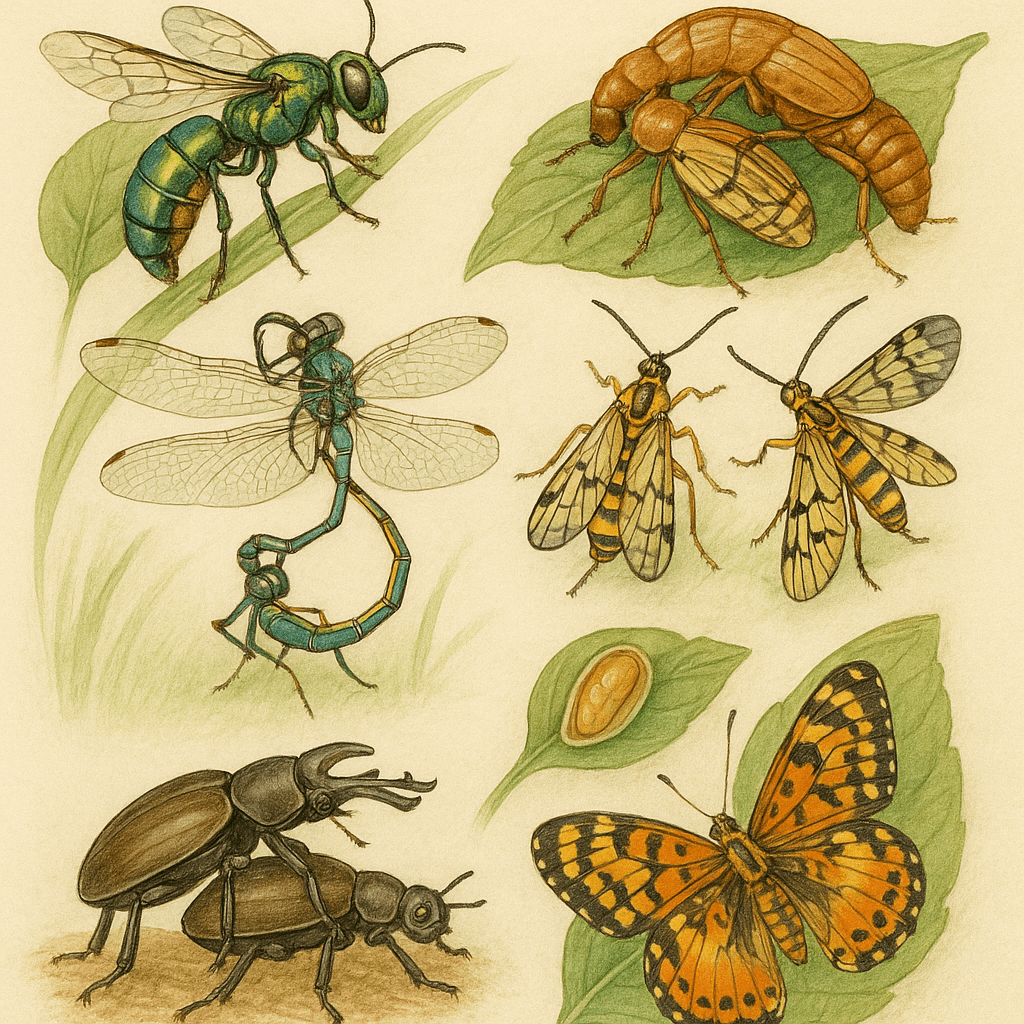
La selezione sessuale negli insetti è un meccanismo chiave dell’evoluzione. Tuttavia, spesso non è solo la specie a determinare chi si accoppia con chi, ma anche la volontà e le strategie dell’individuo. Alcune femmine di mantide religiosa rifiutano partner deboli, mentre i maschi di alcune libellule scelgono femmine che si sono appena nutrite. Queste decisioni rappresentano forme attive di auto-selezione sessuale, dove il successo riproduttivo dipende da micro-scelte individuali.
EN
Sexual selection in insects is a key evolutionary mechanism. However, it is often not just the species that determines who mates with whom, but also the will and strategies of the individual. Some female praying mantises reject weak partners, while males of certain dragonfly species choose females that have just fed. These decisions represent active forms of sexual self-selection, where reproductive success depends on individual micro-choices.
🦠 Selezione immunitaria individuale | Individual Immune Selection
IT
Ogni insetto è esposto a patogeni e parassiti. La risposta immunitaria non è uniforme, ma varia da individuo a individuo. Alcuni insetti producono più melanina nei tessuti lesionati, altri attivano geni antimicrobici più rapidamente. Questo livello di risposta è legato alla condizione fisiologica individuale, quindi possiamo parlare di auto-selezione immunitaria, dove l’efficienza del sistema immunitario personale influenza direttamente la sopravvivenza.
EN
Every insect is exposed to pathogens and parasites. The immune response is not uniform but varies from one individual to another. Some insects produce more melanin in damaged tissues, others activate antimicrobial genes more quickly. This level of response is linked to the individual’s physiological condition, so we can speak of immune self-selection, where the efficiency of the personal immune system directly influences survival.
🌍 Auto-selezione ecologica | Ecological Self-Selection
IT
L’habitat scelto da un insetto può fare la differenza tra vita e morte. Alcune farfalle preferiscono deporre le uova solo su piante con un certo microclima; altri insetti scelgono tane o anfratti più freschi o più secchi in base alle proprie esigenze. La scelta dell’habitat diventa quindi una forma di auto-selezione ecologica, dove l’individuo seleziona l’ambiente più adatto alle sue capacità e limiti.
EN
The habitat chosen by an insect can mean the difference between life and death. Some butterflies prefer to lay eggs only on plants with a certain microclimate; other insects choose burrows or crevices that are cooler or drier depending on their needs. The choice of habitat thus becomes a form of ecological self-selection, where the individual selects the environment best suited to its capabilities and limits.
🧪 Auto-selezione epigenetica | Epigenetic Self-Selection
IT
L’epigenetica è una frontiera recente anche per gli insetti. Alcuni studi suggeriscono che le condizioni ambientali vissute dall’insetto possono modificare l’espressione genica in modo reversibile ma funzionale. Ad esempio, nelle api, il tipo di nutrizione ricevuta dalla larva determina se diventerà operaia o regina. Si tratta di auto-selezione epigenetica, dove il comportamento o l’ambiente scelto dall’individuo può influenzare la sua fisiologia futura.
EN
Epigenetics is a recent frontier even for insects. Some studies suggest that environmental conditions experienced by an insect can alter gene expression in a reversible yet functional way. For example, in bees, the type of nutrition received by the larva determines whether it becomes a worker or a queen. This is epigenetic self-selection, where the behavior or environment chosen by the individual can influence its future physiology.
🔄 Plasticità e auto-selezione dinamica | Plasticity and Dynamic Self-Selection
IT
Molti insetti dimostrano una notevole plasticità fenotipica, cioè la capacità di cambiare aspetto o comportamento in base alle circostanze. Questa flessibilità è una risorsa preziosa in ambienti mutevoli. La capacità di adattamento dinamico, guidata dalle esperienze individuali, è una forma avanzata di auto-selezione, dove l’insetto modifica attivamente le proprie caratteristiche per adeguarsi al contesto.
EN
Many insects exhibit remarkable phenotypic plasticity, meaning they can change appearance or behavior based on circumstances. This flexibility is a valuable asset in changing environments. The capacity for dynamic adaptation, driven by individual experiences, is an advanced form of self-selection, where the insect actively modifies its traits to suit the context.
🧭 Conclusione: L’individuo come forza evolutiva | Conclusion: The Individual as Evolutionary Force
IT
L’evoluzione non è solo un processo cieco che agisce su popolazioni. In molti insetti, l’individuo gioca un ruolo attivo nella selezione del proprio destino, scegliendo comportamenti, ambienti e partner che massimizzano le proprie possibilità. Questa prospettiva di auto-selezione naturale ci invita a vedere l’insetto non solo come un ingranaggio della specie, ma come un’entità autonoma che modella il proprio futuro attraverso decisioni microevolutive.
EN
Evolution is not just a blind process acting on populations. In many insects, the individual plays an active role in selecting its own destiny, choosing behaviors, environments, and partners that maximize its chances. This perspective of natural self-selection invites us to see the insect not only as a cog in the species, but as an autonomous entity shaping its future through microevolutionary decisions.




 458socom.org